Skip to content
Skip to product information
Description

Player One Mars-C II (IMX662) – Designed for Planetary Imaging and EAA

The Mars-C II (IMX662) is the latest evolution in the Mars planetary camera series, engineered by Player One Astronomy for exceptional performance in both planetary imaging and EAA (Electronically Assisted Astronomy). Featuring Sony’s newest IMX662 STARVIS 2 sensor, it delivers ultra-low noise, high sensitivity, and remarkable clarity.

Player One Mars Series astronomy cameras shown in front of Mars, featuring the Mars-M II IMX462 Mono, Mars-C II IMX662 Color, Mars-M IMX290 Mono, and Mars-C IMX462 Color planetary cameras in red-and-black hexagonal housings.

Product Overview

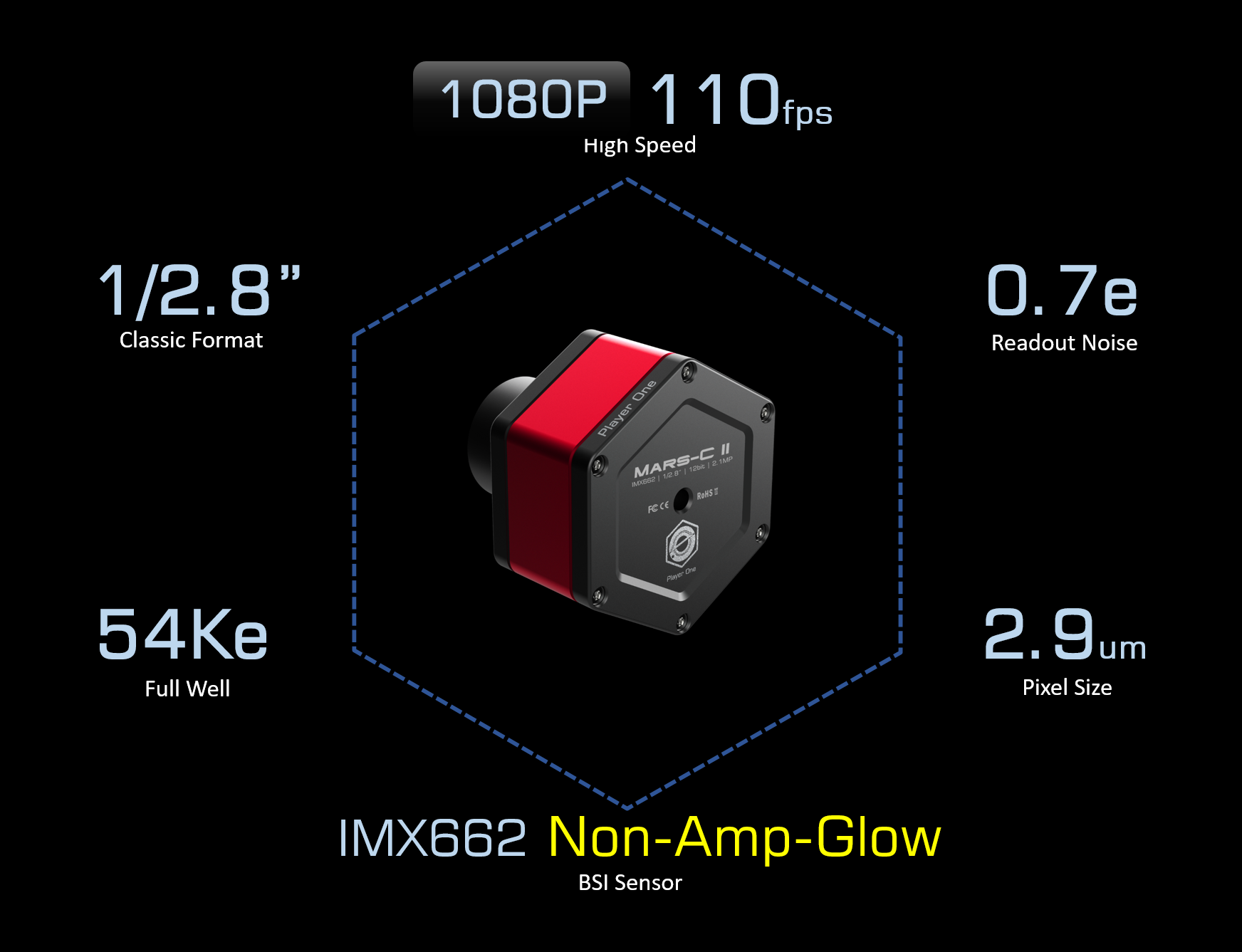
The Mars-C II uses the latest Sony IMX662 sensor, a 1/2.8-inch format CMOS chip with a 2.9 µm pixel size and a full well capacity of 54,000 electrons — a dramatic increase over previous generations. With a resolution of 1936 × 1100 (2.1 MP) and a 6.44 mm diagonal, this camera delivers crisp, high-contrast images of the planets and Moon.

Front view of the Player One Mars-C II astronomy camera showing the hexagonal body and exposed sensor.

STARVIS 2 Technology

The IMX662 sensor incorporates Sony’s newest STARVIS 2 back-illuminated pixel technology, offering superb low-light sensitivity, excellent signal-to-noise performance, and outstanding real-world results.

Sensor Format

The 1/2.8” sensor format is perfectly matched to planetary imaging, providing a sharp, well-sampled image scale for a wide range of telescopes.

Player One Mars-C II planetary camera showing the front sensor opening on a white background.

Diagram showing the IMX662 sensor size with 5.6mm by 3.2mm effective area for the Player One Mars-C II camera.

Extended Full Well Capacity

With a full well depth of 54 ke-, the Mars-C II offers nearly 4.5× the capacity of the older IMX462 sensor. This results in improved dynamic range, smoother gradients, and better colour integrity in bright planetary regions.

Bar chart comparing full well capacity of IMX662 and IMX462 sensors, showing values of 54k electrons for IMX662 and 12k electrons for IMX462.

Highlights

Zero Amp Glow

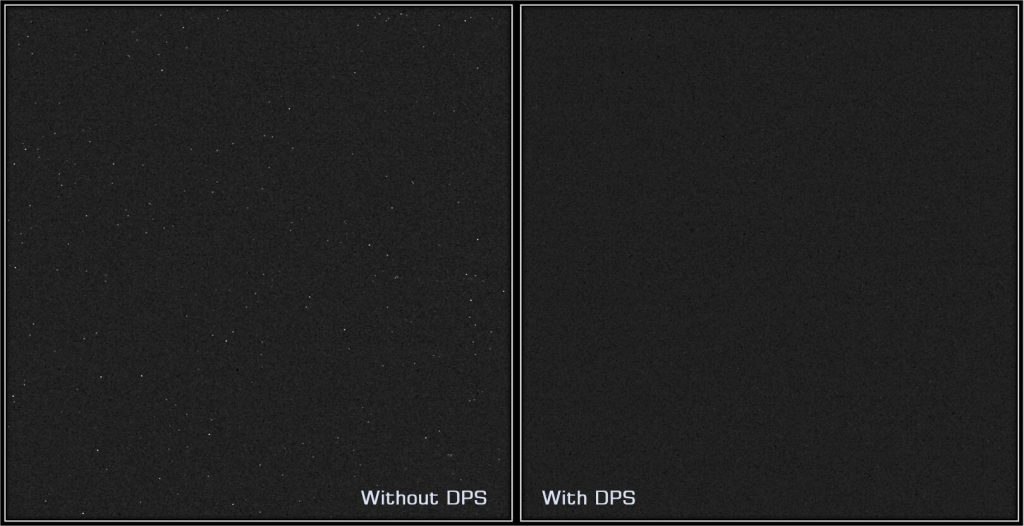
One of the most impressive features of the Mars-C II is its completely amp-glow-free dark frames. Even with heavily stretched 300-second exposures, the background remains perfectly clean — ideal for EAA, lunar imaging, and planetary work.

Side-by-side comparison showing sensor noise without DPS and reduced noise with DPS digital noise suppression technology.

This level of cleanliness makes it easy to extract fine detail and maintain a high-quality background.

High-resolution Jupiter image captured with the Player One Mars-C II camera showing cloud band structure.
Jupiter – John Gleason (10” MCT + Mars-C II)

High-resolution Saturn image taken with the Player One Mars-C II planetary camera.
Saturn – John Gleason (10” MCT + Mars-C II)

High-resolution image of Jupiter captured with a Player One Mars-C camera through a 14-inch Dobsonian telescope
Jupiter – Dan Llewellyn (C14 + Mars-C II)

Feature Overview

Feature overview graphic for the Player One Mars-C II planetary camera showing specifications and key technologies.

Player One uses a unique naming system inspired by planets. Cameras named after Mars represent sensors in the 1/2.8” size class, matching the characteristics of this powerful IMX662-based model.

2nd-Gen Sensor Tilt Plate

The Mars-C II includes an improved tilt plate that allows fine adjustment of sensor orthogonality — extremely helpful when imaging with fast optics or achieving pinpoint stars across the field.

Player One Mars-C camera showing sensor tilt plate and tilt-adjusting screws with labels.

Diagram comparing first and second generation tilt plates with groove depth and sponge spacer differences.

256MB DDR3 Buffer

The built-in 256MB DDR3 cache stabilises data transfer, prevents frame drops, and reduces readout noise — especially beneficial when using slower laptops, older USB ports, or long imaging sessions.

Illustration showing the DDR3 256MB buffer chip used in the Player One Mars-C II for stable data transfer.

DPS Technology (Dead Pixel Suppression)

DPS technology automatically identifies and corrects fixed pattern noise and dead pixels in real time. Each exposure is analysed, producing cleaner raw frames and significantly improving stacked results.
Protection Features

The Mars-C II includes built-in overvoltage and overcurrent protection to safeguard both the camera and your other connected equipment.

Ports and Connectivity

Connected via USB 3.0, the camera can reach up to 107 FPS at full resolution in RAW8 mode. The ST4 port supports autoguiding for those who also wish to use the camera for tracking corrections.

Rear view diagram of the Player One Mars-C II camera showing labeled USB3.0 and ST4 guiding ports.

Performance Charts

Performance charts for the Player One Mars-C II camera showing system gain, full well capacity, dynamic range, and readout noise.

Quantum Efficiency

Quantum efficiency curve of the IMX462 sensor showing red, green, and blue response across wavelengths.

Mechanical Drawing

Technical drawing of the Player One Mars-C II camera showing dimensions, thread sizes, and sensor position.

Package Contents

Player One Mars-C II camera package including camera body, T-mount, cables, hex wrench, dust cap, and air blower.


Mars-C II (IMX662) – Frequently Asked Questions

Q1: Is the Mars-C II good for beginners?

Yes. The camera is extremely easy to use, has no amp glow, and delivers fantastic results even with modest telescopes.

Q2: Is the Mars-C II better than the older IMX462-based models?

Absolutely. It features a much larger full well capacity, lower noise, and improved sensitivity thanks to STARVIS 2 technology.

Q3: Can I use this camera for deep sky?

While primarily a planetary and EAA camera, it can capture bright deep-sky objects using short exposures.

Q4: Does it support autoguiding?

Yes. The ST4 port allows the camera to act as a guide camera when needed.

Q5: What software is compatible?

Supported software includes Sharpcap, FireCapture, ASIStudio, and most major astronomy imaging applications.

Q6: What telescopes work best with the Mars-C II?

Maksutovs, Schmidt-Cassegrains, Newtonians, and APO refractors all pair extremely well with this camera.


Player One Mars-C II Colour Planetary Camera (IMX662)

Sale price £179.00
Regular price £199.00You saved£20.00 OFF

Mars-C II

Specifications

Player One Mars-C II (IMX662) – Designed for Planetary Imaging and EAA

The Mars-C II (IMX662) is the latest evolution in the Mars planetary camera series, engineered by Player One Astronomy for exceptional performance in both planetary imaging and EAA (Electronically Assisted Astronomy). Featuring Sony’s newest IMX662 STARVIS 2 sensor, it delivers ultra-low noise, high sensitivity, and remarkable clarity.

Player One Mars Series astronomy cameras shown in front of Mars, featuring the Mars-M II IMX462 Mono, Mars-C II IMX662 Color, Mars-M IMX290 Mono, and Mars-C IMX462 Color planetary cameras in red-and-black hexagonal housings.

Product Overview

The Mars-C II uses the latest Sony IMX662 sensor, a 1/2.8-inch format CMOS chip with a 2.9 µm pixel size and a full well capacity of 54,000 electrons — a dramatic increase over previous generations. With a resolution of 1936 × 1100 (2.1 MP) and a 6.44 mm diagonal, this camera delivers crisp, high-contrast images of the planets and Moon.

Front view of the Player One Mars-C II astronomy camera showing the hexagonal body and exposed sensor.

STARVIS 2 Technology

The IMX662 sensor incorporates Sony’s newest STARVIS 2 back-illuminated pixel technology, offering superb low-light sensitivity, excellent signal-to-noise performance, and outstanding real-world results.

Sensor Format

The 1/2.8” sensor format is perfectly matched to planetary imaging, providing a sharp, well-sampled image scale for a wide range of telescopes.

Player One Mars-C II planetary camera showing the front sensor opening on a white background.

Diagram showing the IMX662 sensor size with 5.6mm by 3.2mm effective area for the Player One Mars-C II camera.

Extended Full Well Capacity

With a full well depth of 54 ke-, the Mars-C II offers nearly 4.5× the capacity of the older IMX462 sensor. This results in improved dynamic range, smoother gradients, and better colour integrity in bright planetary regions.

Bar chart comparing full well capacity of IMX662 and IMX462 sensors, showing values of 54k electrons for IMX662 and 12k electrons for IMX462.

Highlights

Zero Amp Glow

One of the most impressive features of the Mars-C II is its completely amp-glow-free dark frames. Even with heavily stretched 300-second exposures, the background remains perfectly clean — ideal for EAA, lunar imaging, and planetary work.

Side-by-side comparison showing sensor noise without DPS and reduced noise with DPS digital noise suppression technology.

This level of cleanliness makes it easy to extract fine detail and maintain a high-quality background.

High-resolution Jupiter image captured with the Player One Mars-C II camera showing cloud band structure.
Jupiter – John Gleason (10” MCT + Mars-C II)

High-resolution Saturn image taken with the Player One Mars-C II planetary camera.
Saturn – John Gleason (10” MCT + Mars-C II)

High-resolution image of Jupiter captured with a Player One Mars-C camera through a 14-inch Dobsonian telescope
Jupiter – Dan Llewellyn (C14 + Mars-C II)

Feature Overview

Feature overview graphic for the Player One Mars-C II planetary camera showing specifications and key technologies.

Player One uses a unique naming system inspired by planets. Cameras named after Mars represent sensors in the 1/2.8” size class, matching the characteristics of this powerful IMX662-based model.

2nd-Gen Sensor Tilt Plate

The Mars-C II includes an improved tilt plate that allows fine adjustment of sensor orthogonality — extremely helpful when imaging with fast optics or achieving pinpoint stars across the field.

Player One Mars-C camera showing sensor tilt plate and tilt-adjusting screws with labels.

Diagram comparing first and second generation tilt plates with groove depth and sponge spacer differences.

256MB DDR3 Buffer

The built-in 256MB DDR3 cache stabilises data transfer, prevents frame drops, and reduces readout noise — especially beneficial when using slower laptops, older USB ports, or long imaging sessions.

Illustration showing the DDR3 256MB buffer chip used in the Player One Mars-C II for stable data transfer.

DPS Technology (Dead Pixel Suppression)

DPS technology automatically identifies and corrects fixed pattern noise and dead pixels in real time. Each exposure is analysed, producing cleaner raw frames and significantly improving stacked results.

Protection Features

The Mars-C II includes built-in overvoltage and overcurrent protection to safeguard both the camera and your other connected equipment.

Ports and Connectivity

Connected via USB 3.0, the camera can reach up to 107 FPS at full resolution in RAW8 mode. The ST4 port supports autoguiding for those who also wish to use the camera for tracking corrections.

Rear view diagram of the Player One Mars-C II camera showing labeled USB3.0 and ST4 guiding ports.

Performance Charts

Performance charts for the Player One Mars-C II camera showing system gain, full well capacity, dynamic range, and readout noise.

Quantum Efficiency

Quantum efficiency curve of the IMX462 sensor showing red, green, and blue response across wavelengths.

Mechanical Drawing

Technical drawing of the Player One Mars-C II camera showing dimensions, thread sizes, and sensor position.

Package Contents

Player One Mars-C II camera package including camera body, T-mount, cables, hex wrench, dust cap, and air blower.


Mars-C II (IMX662) – Frequently Asked Questions

Q1: Is the Mars-C II good for beginners?

Yes. The camera is extremely easy to use, has no amp glow, and delivers fantastic results even with modest telescopes.

Q2: Is the Mars-C II better than the older IMX462-based models?

Absolutely. It features a much larger full well capacity, lower noise, and improved sensitivity thanks to STARVIS 2 technology.

Q3: Can I use this camera for deep sky?

While primarily a planetary and EAA camera, it can capture bright deep-sky objects using short exposures.

Q4: Does it support autoguiding?

Yes. The ST4 port allows the camera to act as a guide camera when needed.

Q5: What software is compatible?

Supported software includes Sharpcap, FireCapture, ASIStudio, and most major astronomy imaging applications.

Q6: What telescopes work best with the Mars-C II?

Maksutovs, Schmidt-Cassegrains, Newtonians, and APO refractors all pair extremely well with this camera.

Player One Mars-C II Planetary Camera
Player One Mars-C II Colour Planetary Camera (IMX662)
Drawer Title
Similar Products