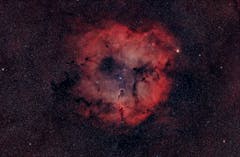
Improved ZWO Narrowband Filters
Since mid-2018, ZWO has supplied an improved version of their narrowband filters. The improvement is most noticeable when imaging night-sky landscapes containing very bright stars, particularly with the H-alpha and SII filters. With the updated OIII filters, the difference is more subtle.
Production of the 2" version began at the end of 2019 and it has only ever been available in this improved form. For this reason, ZWO did not apply a “Mark II” designation, as there was never an earlier version.
What Are Narrowband Filters Used For?
Narrowband filter sets are used to create high-contrast deep-sky images of emission and diffuse nebulae such as the Veil Nebula, Orion Nebula (M42), North America Nebula, Horsehead Nebula, as well as planetary nebulae including the Dumbbell (M27), Ring (M57), and Helix Nebula.
They can be used instead of, or in combination with, LRGB filters. Many astrophotographers also use narrowband filters under moonlight or from heavily light-polluted locations, as they significantly suppress light pollution while enhancing nebular detail.
By using longer exposure times, nebulosity brightness is increased while stars remain relatively subdued. The sky background stays darker, resulting in improved contrast.
Technical Specifications
- Filter size: 2" mounted cell
- Surface quality: Fine-optically polished to 1/4 wavefront accuracy
- FWHM: 7 ± 0.5 nm
- Glass thickness: 2 mm
This filter set includes three filters: H-alpha, OIII, and SII.
Filter Characteristics
H-alpha (7nm)
Centre wavelength: 656 nm. Transmission reaches approximately 90% (minimum 80%). This bandwidth is well suited for high-contrast imaging and revealing fine nebular detail, even in areas affected by strong light pollution.
SII (7nm)
Centre wavelength: 672 nm. Designed for imaging emission nebulae, planetary nebulae, and supernova remnants. Commonly combined with H-alpha and OIII filters for SHO (Hubble palette) astrophotography.
OIII (7nm)
Centre wavelength: 500 nm. Isolates OIII emission lines while blocking unwanted light, enabling dramatic nebular contrast and expanding imaging possibilities beyond traditional RGB methods.
Filter Installation Orientation
ZWO recommends that, for their latest narrowband filters, the coated side should face the telescope.
To identify the coated side, place the filter on a clean surface and hold a small object (such as a pen) just above the glass:
- If you see a single reflection, that is the coated side and it should face the telescope.
- If you see a double reflection, that side has an anti-reflection coating and should face the camera sensor.
Image below shows a double reflection — this side should face the camera:

Image below shows a single reflection — this side should face the telescope:

Transmission Curve